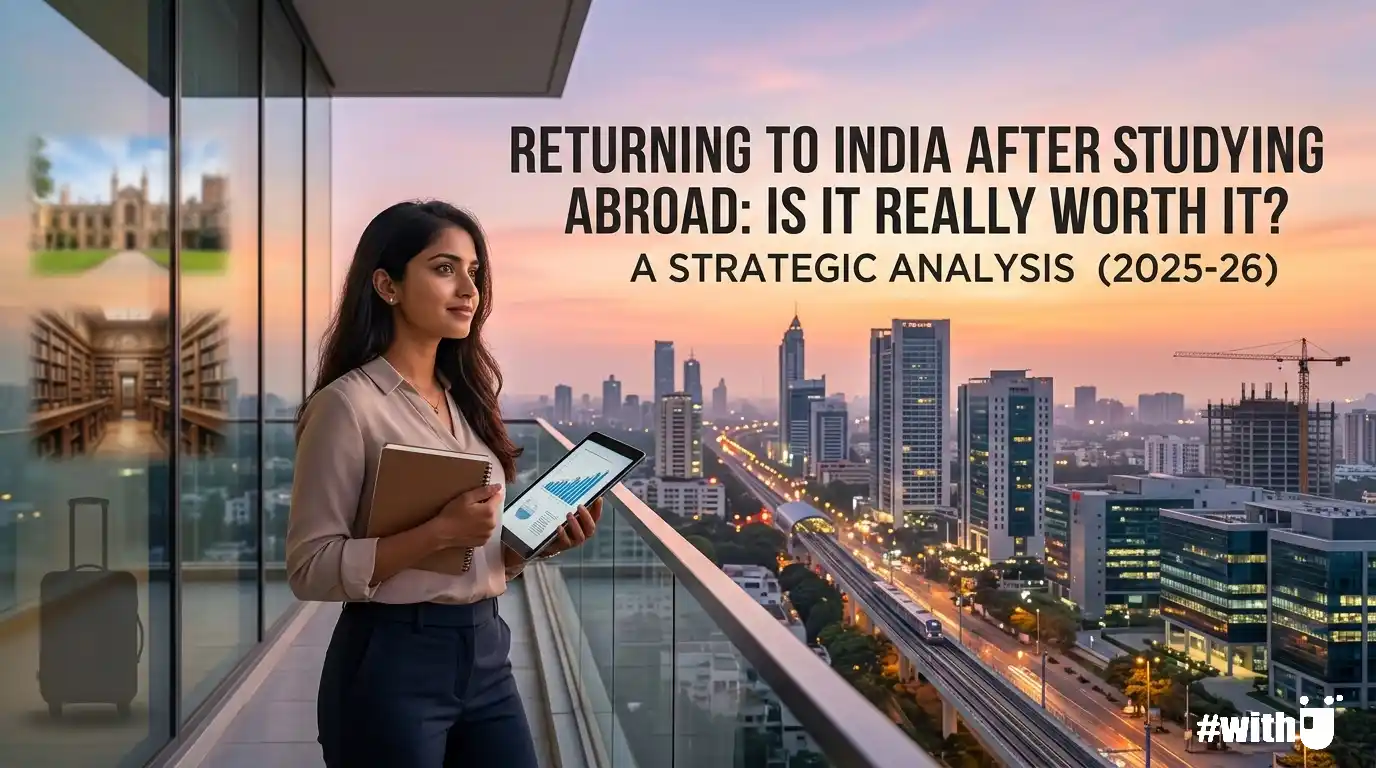

The question “Is it worth returning to India after studying abroad?” is one that echoes in the minds of thousands of students and parents every year. It is a decision often clouded by emotions—homesickness vs. opportunity. However, at Kalinga Euro, we believe this must be answered not emotionally, but practically—by examining hard outcomes, global skills gained, career acceleration cycles, and the long-term Return on investment (ROI).
For many Indian students, choosing to study abroad in Italy or other top European hubs is not an escape from India, but a strategic upgrade before returning. When students re-enter the Indian workforce after an international education, they don’t just return with a degree; they return with higher employability, stronger technical frameworks, and a trajectory for faster career growth compared to their domestic peers.
1. Higher Return on Investment (ROI) Over Time
A common misconception is that the high upfront cost of international education only pays off if you settle in the West. In reality, the real-time career opportunities in India for returnees are expanding rapidly. The ROI isn’t just limited to the first paycheck; it appears over time through faster promotions, higher levels of responsibility, and long-term earning growth.
Students trained in countries like Germany, Italy, or the UK are accustomed to performance-based evaluation and extreme accountability. When they join the Indian workforce—especially in multinational corporations (MNCs)—they adapt faster and contribute earlier. This leads to quicker career progression where a small acceleration in the early years can compound into significantly higher lifetime earnings.
2. The Global Skill Advantage: What Indian Employers Value
International education emphasizes application, problem-solving, and communication. These skills are still relatively scarce in many entry-level graduates in India, which gives returnees a clear competitive edge.
- Why employers prefer returnees:
- Minimal Training Needed: They are already familiar with global industry standard tools.
- Communication Prowess: They communicate more clearly and professionally across time zones.
- Independent Decision-Making: They handle responsibility with greater confidence.
- Cultural Adaptability: They adapt easily to multinational and global-facing roles.
3. Sector-Wise Career Outcomes & Realistic Earnings
Knowing what actually happens on the ground after return is crucial. Here are the realistic earning brackets and roles for students returning to India in 2025-26:
A. Computer Science, Data Science, & Cybersecurity
Students return with hands-on experience in modern programming frameworks and cloud platforms. Unlike fresh domestic graduates, they are already familiar with high-intensity industry workflows.
- Roles: Software Developer, AI/ML Engineer, Data Scientist, Cybersecurity Analyst, Cloud Architect.
Realistic Earnings:
– International Bachelor’s: ₹6–10 lakhs per annum
– International Master’s: ₹10–18 lakhs per annum
– Growth (4–6 Years): ₹20–30 lakhs as you move into architect or product lead roles.
B. Engineering (Mechanical, Electrical, Robotics, Automotive)
Engineering programs abroad focus heavily on applied learning and simulations. Firms like Tata Motors, Reliance, and global consultancies value this design-tool exposure.
Realistic Earnings:
– Fresh Returnees: ₹5–8 lakhs per annum
– Senior/Specialized Roles (3-5 years): ₹12–20 lakhs per annum, especially in robotics and automation.
C. Business, Management, & Finance
Returnees bring strong analytical skills and exposure to global business practices, which are highly valued in India’s consulting sectors.
Realistic Earnings:
– Initial Range: ₹7–12 lakhs per annum
– Master’s/Strong Profiles: ₹12–20 lakhs per annum
– Managerial Growth (5-7 years): ₹25 lakhs or more.
D. MBBS and Healthcare Programs
Studying MBBS abroad provides exposure to diverse healthcare systems and structured clinical training. Once registered with the NMC (after clearing the FMGE/NEXT), foreign medical graduates practice on par with Indian graduates.
Realistic Earnings:
– Entry-Level Clinical Roles: ₹6–10 lakhs per annum. ROI is often superior because the lower education cost (e.g., in Italy with scholarships) makes the debt-to-income ratio much healthier than private medical colleges in India.
Financial Comparison: Studying Abroad vs. India
| Metric | India (Private Tier-1) | Study Abroad (Europe) | Benefit |
| Tuition Cost | ₹25L – ₹60L+ | ₹0 – ₹15L (with scholarships) | Significant Savings |
| Starting Salary | ₹4L – ₹8L | ₹6L – ₹12L | Higher Entry Point |
| Time to Lead Role | 6-9 Years | 4-6 Years | Faster Acceleration |
| Global Reach | Moderate | Very High | Infinite Flexibility |
4. Personal Growth That Impacts Professional Success
Beyond the paycheck, living abroad builds independence, discipline, and resilience. Managing finances and navigating foreign systems translate directly into better workplace maturity and decision-making skills—traits that Indian employers actively headhunt.
Conclusion: Is It Worth It?
If your goal is only to earn a degree, domestic education is sufficient. But if your goal is a long-term career upgrade, then returning to India after studying abroad is one of the most powerful moves you can make. The combination of international exposure and the booming Indian economy creates a ‘Sweet Spot’ for career success.
Ready to start your journey? Contact Kalinga Euro today for a free profile assessment and find out how you can study abroad with scholarships.